Sourced narrative
Each block is a verifiable statement. The number opens the cited page; amber or coral blocks flag tradition or contested interpretation.
9 statements
01Evidence and context
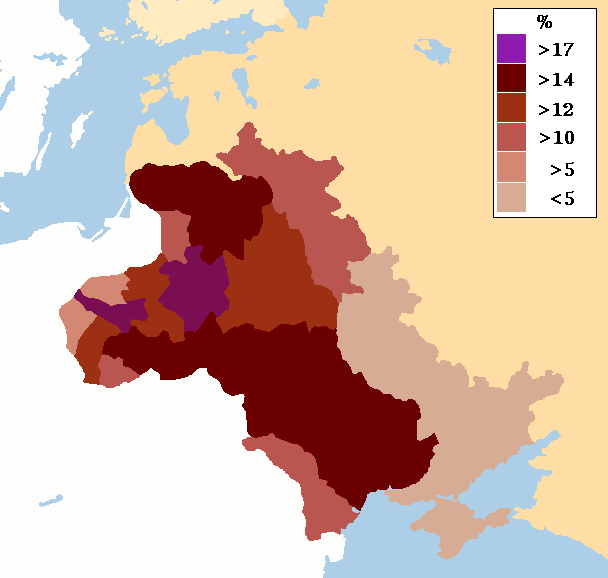
Russia's urban Jewish population increased by about one million from 1897 to 1910.
Odessa's Jewish residents numbered 200,000 in 1912, against 55,000 in 1880.
Warsaw reached 337,000 Jewish residents in 1910, or 38 percent of its population.
Numerous Pale cities had Jewish majorities or very large minorities.
Between 1881 and 1917, New York's Jewish population reached 1.5 million.
Jews then accounted for 26.4 percent of New York.
Jewish urban concentration also marked Australia, Argentina, Brazil, Uruguay, and Muslim lands.
Cities expanded Jewish access to industry, commerce, professions, and new ideologies.
Hostile nationalists portrayed Jewish urban life as estrangement from national soil.
Context
Warsaw reached 337,000 Jewish residents in 1910, or 38 percent of its population.
Numerous Pale cities had Jewish majorities or very large minorities.
Between 1881 and 1917, New York's Jewish population reached 1.5 million.
§ 01Geography
Where it happened
§ 02Museum
Objects and images
§ 03Historiography
What scholars debate
Scholarly debate · 01
Was Jewish concentration urbanization or metropolitanization?
2 positions · no single answer · take a seat →
- A
Broad urban migration
Social synthesis
Jews left villages and small towns for urban opportunity.
- B
Metropolitan concentration
Salo Baron
An unusual share concentrated in a small number of giant cities.
§ 04Network
Connections
§ 05Bibliography
Further reading
No specific reading recorded for this event.
§ 06Apparatus
Sources on this page
- 01Efron, Lehmann and Weitzman, p. 337inspect
- 02Efron, Lehmann and Weitzman, p. 337inspect
- 03Efron, Lehmann and Weitzman, p. 337inspect
- 04Efron, Lehmann and Weitzman, p. 337inspect
- 05Efron, Lehmann and Weitzman, p. 338inspect
- 06Efron, Lehmann and Weitzman, p. 338inspect
- 07Efron, Lehmann and Weitzman, p. 338inspect
- 08Efron, Lehmann and Weitzman, p. 338inspect
- 09Efron, Lehmann and Weitzman, p. 338inspect
- Documented evidenceAttested by contemporary evidence: texts, inscriptions, coins, papyri or archaeology.
- Scholarly reconstructionHistorians' inference from indirect evidence.
- Tradition or narrativeA literary, traditional or religious account; significant in itself, but not independently verified.
- Contested interpretationScholars explicitly disagree; see the positions in the debate.
- Illustrative reconstructionA hypothesis or visual scheme to guide reading; not a historical claim.