Sourced narrative
Each block is a verifiable statement. The number opens the cited page; amber or coral blocks flag tradition or contested interpretation.
12 statements
01Evidence and context
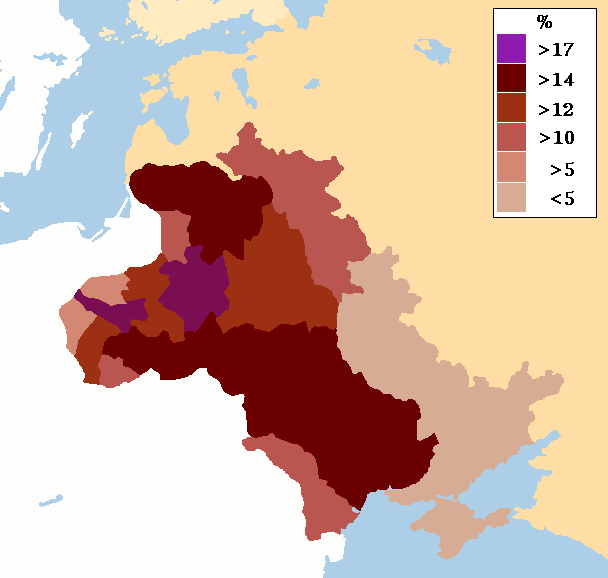
Russia acquired its large Jewish population through the partitions of Poland.
A 1791 law confined Jews to territories later called the Pale of Settlement.
The Pale housed nearly five million Jews and was approximately the size of France, Germany, and Austria combined.
In the nineteenth century, the Russian Empire housed roughly five million Jews.
Russia's 1804 statute sought to place Jews in existing occupational categories.
The statute opened schools and municipal councils and offered support for agriculture.
The village alcohol ban threatened to displace many Jews from the countryside.
The government formally abolished the kahals in 1844, though many continued clandestinely.
State-sponsored Jewish schools attracted few pupils and failed as an integration program.
Before World War I, Yiddish literacy encompassed nearly every Jewish boy and a majority of Jewish girls.
After the kahal crisis, wealthy merchants replaced part of the traditional rabbinic leadership.
By the mid-nineteenth century, Jews formed three-quarters of registered merchants in the Pale.
Context
The Pale housed nearly five million Jews and was approximately the size of France, Germany, and Austria combined.
In the nineteenth century, the Russian Empire housed roughly five million Jews.
Russia's 1804 statute sought to place Jews in existing occupational categories.
§ 01Geography
Where it happened
§ 02Museum
Objects and images
§ 04Network
Connections
§ 05Bibliography
Further reading
John Klier, Russia Gathers Her Jews: The Origins of the Jewish Question in Russia, 1772 to 1825 (DeKalb: Northern Illinois University Press, 1986).
Origins of Russia's Jewish question · recommended in Efron, Lehmann and Weitzman, p. 289
§ 06Apparatus
Sources on this page
- 01Efron, Lehmann and Weitzman, p. 284inspect
- 02Efron, Lehmann and Weitzman, p. 285inspect
- 03Efron, Lehmann and Weitzman, p. 284inspect
- 04Efron, Lehmann and Weitzman, p. 284inspect
- 05Efron, Lehmann and Weitzman, p. 285inspect
- 06Efron, Lehmann and Weitzman, p. 285inspect
- 07Efron, Lehmann and Weitzman, p. 285inspect
- 08Efron, Lehmann and Weitzman, p. 287inspect
- 09Efron, Lehmann and Weitzman, p. 287inspect
- 10Efron, Lehmann and Weitzman, p. 287inspect
- 11Efron, Lehmann and Weitzman, p. 287inspect
- 12Efron, Lehmann and Weitzman, p. 287inspect
- Documented evidenceAttested by contemporary evidence: texts, inscriptions, coins, papyri or archaeology.
- Scholarly reconstructionHistorians' inference from indirect evidence.
- Tradition or narrativeA literary, traditional or religious account; significant in itself, but not independently verified.
- Contested interpretationScholars explicitly disagree; see the positions in the debate.
- Illustrative reconstructionA hypothesis or visual scheme to guide reading; not a historical claim.