Rabbis nearly invisible beyond their texts
Date
501CE
sixth or seventh century CEapproximate date
The rabbis hardly appear in the archaeology; a late synagogue inscription with laws known from rabbinic texts is one of the few proofs of their influence.
Sourced narrative
Each block is a verifiable statement. The number opens the cited page; amber or coral blocks flag tradition or contested interpretation.
10 statements
01Nearly invisible rabbis
Outside rabbinic texts, rabbis rarely appear; the magic bowls, for instance, sometimes mention Yehoshua bar Perahya, a rabbi that literature knows. But the archaeology and inscriptions of Palestine and elsewhere show almost no sign of the great names of the Mishnah and Talmud.
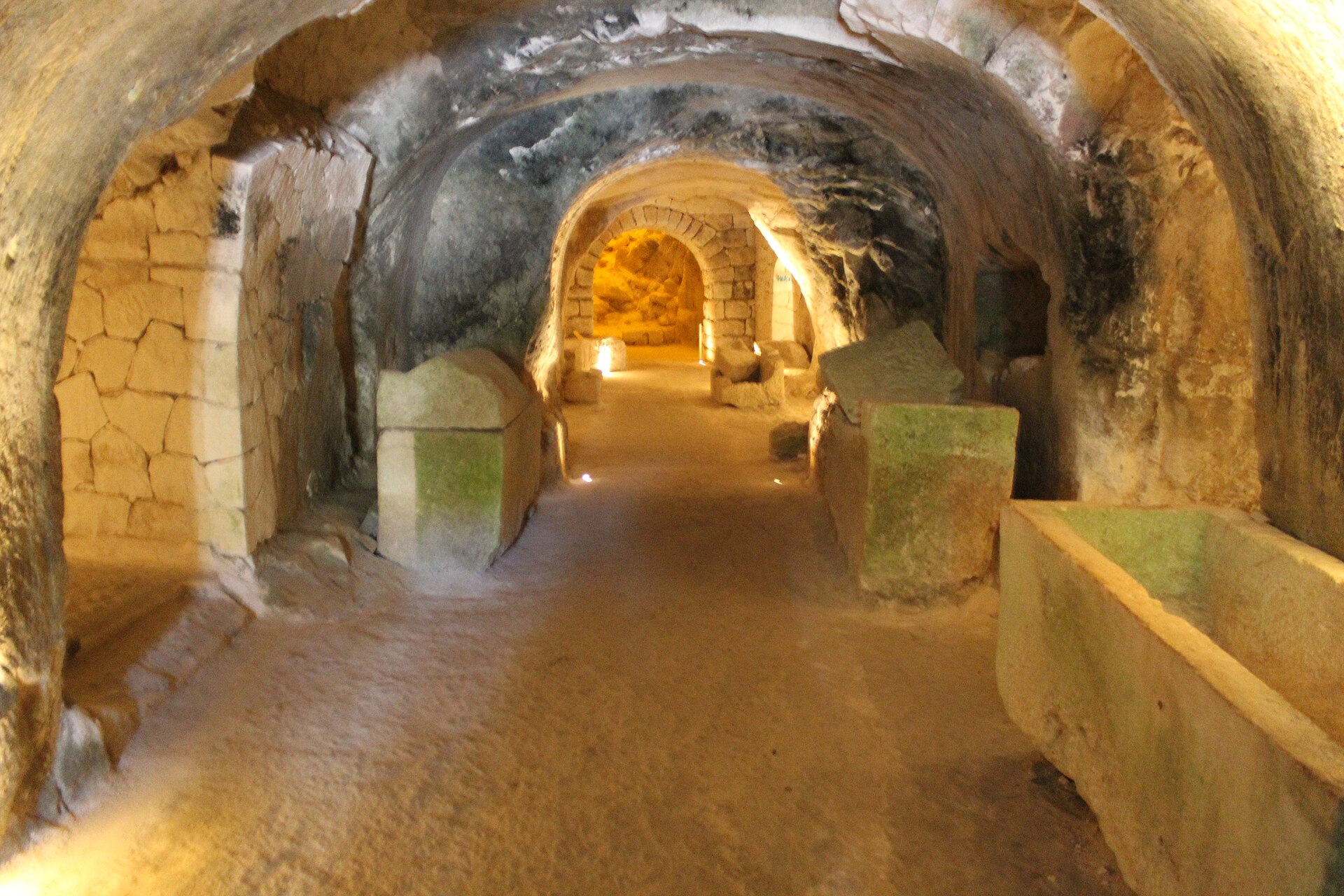
Beside the town of Beth Shearim, in Galilee, lies a vast cemetery of about 30 catacombs, in use from the second to the fourth century. Graves of several rabbis turned up there, three of them successors of Judah the Patriarch. Tradition says that when Judah died, Jews from all over the Roman world wanted to be laid to rest near him.
In northern Israel, an inscription probably of the fourth century identified a building as Rabbi Eliezer ha-Qappar's study house, another name familiar from rabbinic literature. Evidence of this kind confirms that there were rabbis in Palestine but says little about their activity and influence: they belonged to Jewish society without yet holding the central place they would have in the Middle Ages and modern times.
This raises a puzzle that occupies scholars: in hindsight we know that the rabbis, or at least their literature, ended up redefining Jewish identity across much of the world. How did a handful of sages, with almost no visible effect outside their study circles, manage that?
02The inscription
An inscription from the synagogue at Rehov, in the Beth Shean Valley, from the sixth or seventh century, cites laws on tithes and agriculture that parallel the Tosefta and the Palestinian Talmud, and mentions 'Rabbi', perhaps Judah ha-Nasi. It is evidence that rabbinic literature was already influencing synagogue life in some communities.
03Little evidence
But this is little evidence, and late. When did the rabbis begin to influence the wider community, the courts, the synagogues, the prayers of non-rabbis? Despite much research, the answers remain elusive.
When the Mishnah and Talmud debate such matters, the discussion seems mostly theoretical: it dealt with law, but not necessarily law as practiced, to the point that the Mishnah regulates the worship of a Temple that no longer existed. And judging by synagogue art and other evidence of religious practice, the rabbis had little effect on the community in their time; rabbinic literature itself concedes that many did not follow its prescriptions.
In late antiquity this conception of the Torah was confined to a small group of intellectuals, with little evidence of effect on the wider community. That began to change at the end of the period and above all in the Islamic era, through the Geonim's influence.
Context
These sages set the transformation in motion, but Jewish culture as a whole became broadly 'rabbinized' only a long time after they had died. Over the centuries after the Second Temple fell, a group of sages formed to whom we now give the title rabbi. They changed Judaism lastingly: they rethought what the Torah was and how to study it, found paths to God that did without the Temple, and produced new works (Mishnah, midrash, Talmud) that came to guide Jewish life with a weight comparable to the Hebrew Bible's. How much they counted in their own time is hard to say, but their effect on later Jewish culture was so great that present-day Judaism is in practice a rabbinic Judaism, shaped by ideas and practices of late antiquity.
§ 01Geography
Where it happened
§ 02Museum
Objects and images

§ 04Network
Connections
§ 05Bibliography
Further reading
Lee Levine, The Ancient Synagogue: The First Thousand Years (New Haven, CT: Yale University Press, 2000).
Religious life and the ancient synagogue · recommended in Efron, Lehmann and Weitzman, p. 153
§ 06Apparatus
Sources on this page
- 01Efron, Lehmann and Weitzman, p. 140; Efron, Lehmann and Weitzman, p. 140; Efron, Lehmann and Weitzman, p. 140; Efron, Lehmann and Weitzman, p. 140inspect
- 02Efron, Lehmann and Weitzman, p. 130inspect
- 03Efron, Lehmann and Weitzman, p. 130; Efron, Lehmann and Weitzman, p. 147inspect
- 04Efron, Lehmann and Weitzman, p. 131; Efron, Lehmann and Weitzman, p. 131inspect
- 05Efron, Lehmann and Weitzman, p. 131inspect
- 06Efron, Lehmann and Weitzman, p. 140inspect
- 07Efron, Lehmann and Weitzman, p. 151inspect
- 08Efron, Lehmann and Weitzman, p. 151inspect
- 09Efron, Lehmann and Weitzman, p. 121inspect
- 10Efron, Lehmann and Weitzman, p. 120; Efron, Lehmann and Weitzman, p. 120; Efron, Lehmann and Weitzman, p. 120inspect
- Documented evidenceAttested by contemporary evidence: texts, inscriptions, coins, papyri or archaeology.
- Scholarly reconstructionHistorians' inference from indirect evidence.
- Tradition or narrativeA literary, traditional or religious account; significant in itself, but not independently verified.
- Contested interpretationScholars explicitly disagree; see the positions in the debate.
- Illustrative reconstructionA hypothesis or visual scheme to guide reading; not a historical claim.