Dhimmi status takes shape
Date
661CE
661–750 CE
Under the Umayyads a Muslim minority ruled largely non-Muslim populations, and dhimmi status, later associated with the Pact of Umar, set the terms of the Jews' protection and subordination.
Sourced narrative
Each block is a verifiable statement. The number opens the cited page; amber or coral blocks flag tradition or contested interpretation.
12 statements
01The Umayyad dynasty
The first four caliphs ruled from Medina. Mu'awiya then founded the first caliphal dynasty, the Umayyad, and moved the capital to Damascus; it lasted until 750, by which time the empire ran from the Atlantic to the Indus delta. Expansion into Christian Europe was halted by the defeat at Tours (732) and the failed siege of Constantinople (717 to 718).
Muslims long remained a minority within their vast empire, as Islamization lagged behind political and military control. Calculations suggest that as late as the 10th century most Egyptians were still Copts, while Christians formed a majority in northern Syria into the 1100s.
Under these circumstances the shift to Islamic rule was probably not especially traumatic and may even have been welcome to many non-Muslim populations. Jews were used to being a religious minority, and their legal standing under Islam proved much like what they had known in Roman and Byzantine law; for the Middle Eastern Christians too, mostly Monophysites who resented Orthodox Byzantine rule, the change may have been smaller than one would suppose.
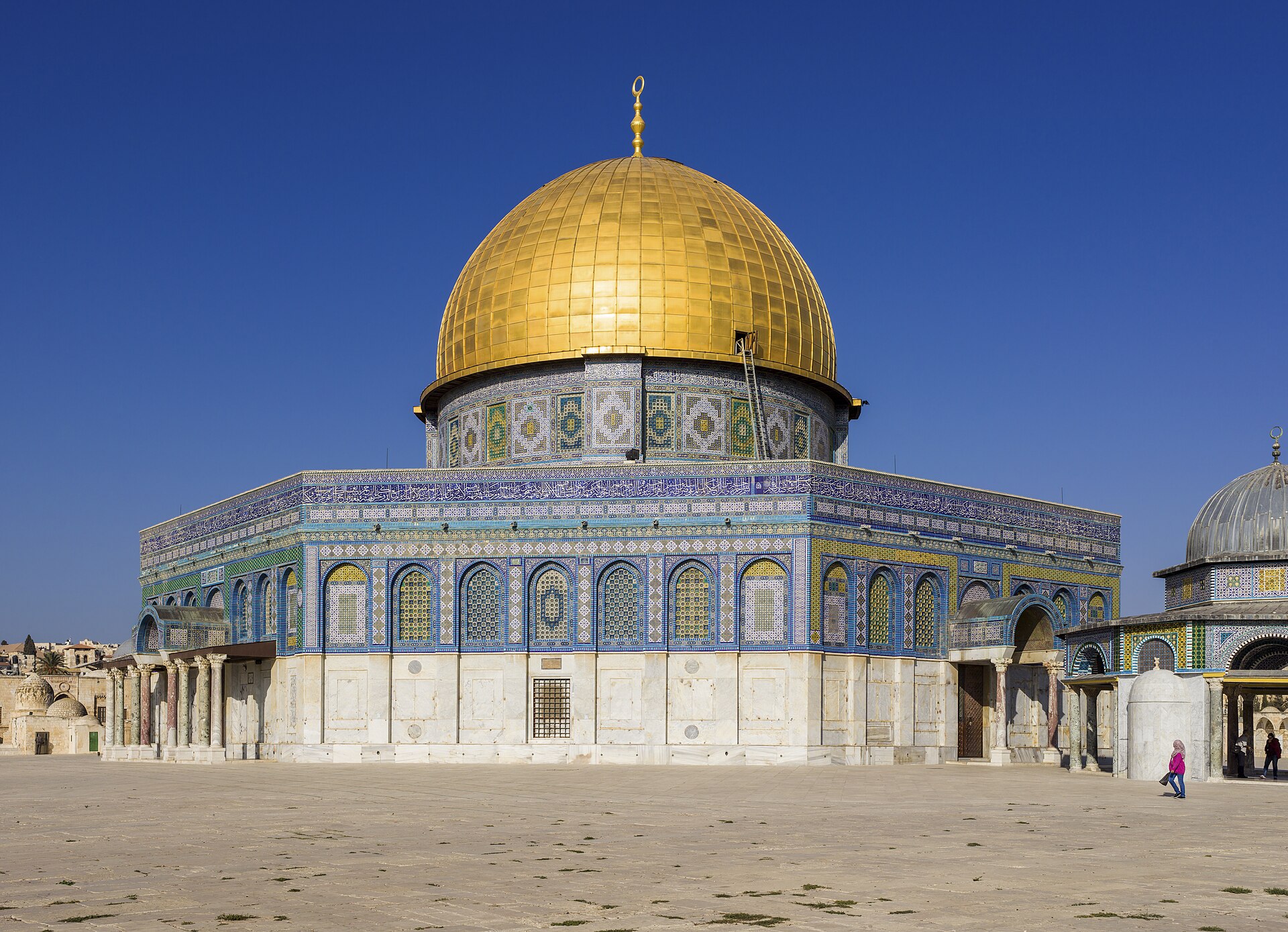
The label of illustration 6.1 notes that Jerusalem's Dome of the Rock was raised under Umayyad caliph Abd al-Malik (685 to 705) on the Temple's site, and that Jerusalem acquired religious meaning in Islam and became a major destination of pilgrimage for Muslims, as it was for Jews and Christians.
02Dhimmi status
Since imposing the new faith by force across so vast a territory would have been impossible, and since the Qur'an declares there is no compulsion in religion, Islamic law (shari'a) recognized the continued presence of Jewish and Christian communities. Treated as dhimmis, 'protected people', Jews and Christians had their lives and religious freedom guarded in return for a special poll tax, the jizya.
03The Pact of Umar
Tradition or narrative
The conditions governing relations between dhimmis and Muslims appear in the so-called Pact of Umar, which tradition ascribes to the 2nd caliph, Umar ibn al-Khattab (634 to 644). The oldest known version of the text, however, dates from the tenth century.
More striking than the Pact of Umar's clauses is its form: it was framed as a treaty binding both sides. Jews and Christians accepted the restrictions, and the Muslim state recognized a set place for their communities. Legal protection thus did not hinge on the whim of each ruler but was written into Islamic law as a basic principle.
Several clauses reflected conditions of the early conquest years: dhimmis were not to shelter spies or bear weapons, rules that arguably served the young empire's security more than any theological aim.
Another clause barred building new houses of worship or restoring ruined ones, likely derived from a similar Byzantine restriction on synagogues. Over time loopholes were made and ways around the ban were found: the synagogues and churches in Muslim-founded cities such as (new) Cairo, Kufa and Baghdad bear witness to it.
Other conditions served to enforce a social hierarchy symbolically, with dhimmis in an inferior though legally secured position: rising before Muslims, not riding on saddles, not building houses taller than theirs. Public showing of dhimmi religions was also restricted, at first perhaps to shield the young Muslim community from their influence and later to mark the hierarchy, and selling wine to Muslims was forbidden.
Context
Jews and Christians, the 'people of the book', were granted peace and safeguards in exchange for a tribute, the jizya, which later became a regular poll tax. The basis is a Qur'anic verse (9:29) that calls for fighting those given the Scriptures until they pay the tribute. The Muslim community was expected to wage war on those who refused Islam, but unlike pagans, who in theory could only convert or die, Jews and Christians would be left alone if they acknowledged Muslim political supremacy, paid the tribute and accepted an inferior, humbled status in Islamic social order.
§ 01Geography
Where it happened
§ 02Museum
Objects and images
§ 03Historiography
What scholars debate
Scholarly debate · 01
Was the Pact of Umar a rule applied to the letter?
2 positions · no single answer · take a seat →
- A
A code going back to Caliph Umar
The traditional attribution
Tradition attributes the text to the second caliph, Umar ibn al-Khattab, as a rule for coexistence between Muslims and dhimmis.
- B
A late text, applied conditionally
Efron, Lehmann and Weitzman
The oldest known version is from the tenth century, and its basic conditions were broken more often than kept: only when other interests were at stake, such as political rivalry or economic tension, did authorities enforce them strictly.
§ 04Network
Connections
§ 05Bibliography
Further reading
Bernard Lewis, The Jews of Islam (Princeton, NJ: Princeton University Press, 1985).
One-volume history of the Jews under Islam · recommended in Efron, Lehmann and Weitzman, p. 181
Norman Stillman, Jews of Arab Lands (Philadelphia: Jewish Publication Society of America, 1979).
Survey and translation of primary sources on Jews of Arab lands · recommended in Efron, Lehmann and Weitzman, p. 181
§ 06Apparatus
Sources on this page
- 01Efron, Lehmann and Weitzman, p. 157; Efron, Lehmann and Weitzman, p. 157inspect
- 02Efron, Lehmann and Weitzman, p. 157; Efron, Lehmann and Weitzman, p. 157; Efron, Lehmann and Weitzman, p. 521inspect
- 03Efron, Lehmann and Weitzman, p. 157; Efron, Lehmann and Weitzman, p. 157; Efron, Lehmann and Weitzman, p. 521inspect
- 04Efron, Lehmann and Weitzman, p. 157inspect
- 05Efron, Lehmann and Weitzman, p. 157; Efron, Lehmann and Weitzman, p. 157inspect
- 06Efron, Lehmann and Weitzman, p. 162inspect
- 07Efron, Lehmann and Weitzman, p. 157; Efron, Lehmann and Weitzman, p. 157inspect
- 08Efron, Lehmann and Weitzman, p. 157inspect
- 09Efron, Lehmann and Weitzman, p. 157; Efron, Lehmann and Weitzman, p. 157inspect
- 10Efron, Lehmann and Weitzman, p. 157; Efron, Lehmann and Weitzman, p. 157; Efron, Lehmann and Weitzman, p. 157inspect
- 11Efron, Lehmann and Weitzman, p. 156; Efron, Lehmann and Weitzman, p. 156inspect
- 12Efron, Lehmann and Weitzman, p. 156inspect
- Documented evidenceAttested by contemporary evidence: texts, inscriptions, coins, papyri or archaeology.
- Scholarly reconstructionHistorians' inference from indirect evidence.
- Tradition or narrativeA literary, traditional or religious account; significant in itself, but not independently verified.
- Contested interpretationScholars explicitly disagree; see the positions in the debate.
- Illustrative reconstructionA hypothesis or visual scheme to guide reading; not a historical claim.